
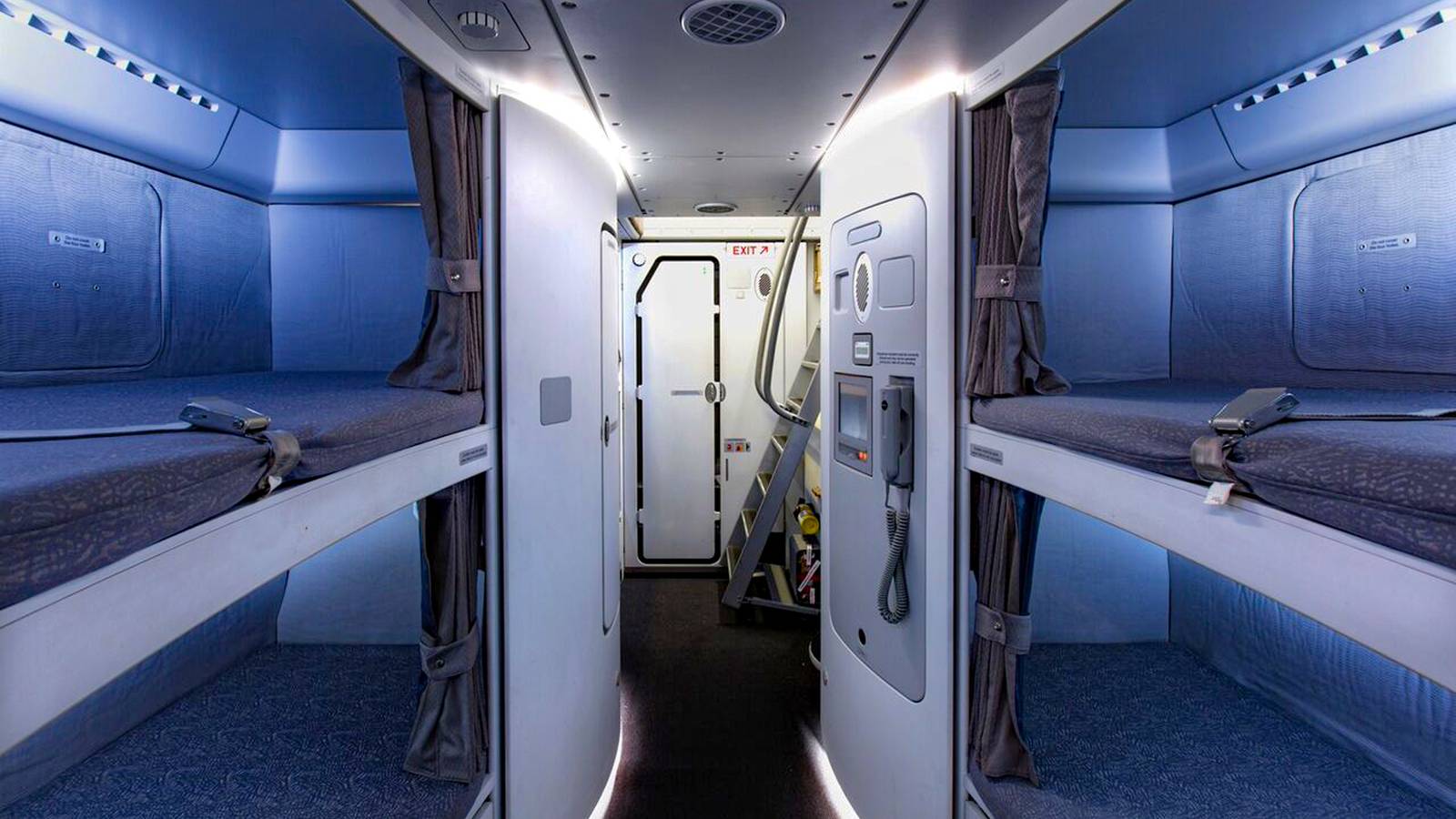
On the Airbus A380, crew rest is not just a spare jumpseat shrouded by a curtain, but rather an entirely dedicated sleeping space that has been built into the aircraft for the people working on your specific flight. On the long-haul sectors, airlines will roster large cabin teams and rotate them through planned breaks so that service remains consistent, and, more importantly, so that the crew stays alert for the moments that really matter, like turbulence, medical issues, diversions, or an evacuation.
The A380’s scale makes this kind of rotation easier as the aircraft has room for proper, crew-only rest infrastructure. What passengers experience as a two-deck superjumbo jet often includes a hidden area that has been fitted with multiple bunks. The idea behind this is simple. Cabin crew members, when their allocated break time arrives, are actually able to lie flat and sleep rather than trying to doze upright.
These compartments are not luxurious, but they are designed around recovery, privacy, controlled lighting, ventilation, charging points, and the safety equipment that is required for sleeping onboard a pressurized jet. The A380’s crew rest area makes it a favorite of cabin crews all across the globe. Let’s see where these compartments sit, how they are accessed, what they contain, and how airlines schedule rest so that cabin service is offered from pushback all the way to touchdown.
A Third Passenger Deck Built For Cabin Crew Comfort

Airbus A380s effectively have three different levels. Beyond the two passenger decks, which everyone sees, there is also a dedicated cabin crew resting area, which is almost always housed on the lowest deck. This resting area is typically fitted with bunk beds and often even has a private restroom that can be used by the crew. The placement of this specific rest area matters a lot for overall crew comfort.
This helps keep off-duty crew away from passenger noise, as well as the traffic of galleys, call bells, and lavatories. It also allows airlines to preserve revenue cabin space on the main decks. A typical ultra-long-haul operation can carry more than 400 passengers with a large cabin team. Airbus quotes an example of 21 cabin crew alongside three pilots in the cockpit, creating a need for staggered and predictable crew rest periods, according to Executive Traveller.
When a jet is serving hundreds of passengers and multiple different decks, the crew cannot simply disappear for an hour. Therefore, the need for controlled rest periods across different rotations is critical to make sure each cabin is covered. You can think of the crew rest compartment as part of the aircraft’s overall safety architecture. This exists so that the crew you meet upon landing is not always the same people who have been on their feet since the aircraft was boarded at its origin.
Finding The Door: Discreet Access Is Key

The Airbus A380’s crew rest is designed to be both secure and almost invisible from a passenger perspective. From inside the cabin, access may look like a service door with a small crew-only sign, the kind of panel that will have passengers walking by without a second thought. The camouflage is thus intentional, as it keeps the flow of passengers smooth and protects a space that must remain controlled.
The A380’s most common configuration is a 12-berth module underneath the main deck, taking away what otherwise could be cargo-hold volume. The presence of this kind of crew rest has also often been cited as a factor limiting the aircraft’s ability to cater to freight-oriented clients. The entry door is often near a stairway halfway along the economy cabin, next to crew seats between rows 65 and 66. Behind the door is a steep and narrow stairwell that drops into a bunk area.
What operators also value about the Airbus A380 is the jet’s impressive redundancy. The plane has a missing passenger seat because the floor conceals an escape hatch for off-duty crew if the normal door cannot be used for whatever reason. Even the sleeping room inside the cabin crew rest area is treated by the airline as a critical compartment, not some kind of lavish upgrade that airlines make for their crew.

Why Is British Airways Refitting Its Airbus A380 Cabins?
A major upgrade is coming to British Airways’ A380 fleet, but what surprises does the new first class cabin hold?
Inside The Bunkroom: What Comforts Are Crewmembers Actually Offered?

If you step into the cabin crew rest area of an A380, the vibe of a superjumbo jet quickly disappears. The core of the aircraft crew rest area is simple, as there are multiple real beds. Crew rest areas use padded mattresses in individual compartments, all of which are separated by sound-dampening curtains to ensure privacy.
They are not designed for lounging in pairs or stretching out. Rather, they are designed so that a tired crewmember can lie flat, switch off the lights, and comfortably wake up when the roster indicates that it is the appropriate time.
The details here are small but equally important in nature. The bunks inside these cabins are typically fitted with reading lights, power outlets, a mirror, and hooks or nooks that stop loose items from sliding around. Safety is integrated into the design of these sleeping spaces. This includes oxygen masks, seat-belt indicators, and an intercom so that the resting crew can be contacted if needed. You cannot forget that you are still inside a massive intercontinental aircraft.
Social-media perceptions of the Airbus A380 crew rest area often trigger similar reactions from viewers, many of whom will immediately make the comment that these cabin crew areas seem claustrophobic. These compartments are compact, windowless, and utilitarian, meaning that this is likely a relatively fair critique. However, they do their job and give cabin crew a genuine opportunity to rest, something which helps keep long-haul crews functional.
Separate Facilities For Cabin Crew & Pilots

Onboard the Airbus A380, crew rest is not just a single room shared by everyone. Cabin crew and pilots typically have separate facilities, and they are built around different individual needs. Cabin crew rotate in and out of service roles, so their rest space is thus optimized for multiple blocks of sleep and quick returns to the cabin. Pilots, by contrast, need a setting that supports deep rest before they step back into an incredibly high-concentration environment.
Most Airbus A380s will have a dedicated pilot rest area located directly at the front of the aircraft within the same secure zone as the cockpit itself. This area is often described as having a distinctive comfort difference versus a bunk model, as it tends to feature a separate armchair alongside notably more overhead space. This makes sense as getting up, orienting oneself, and transitioning back to the flight deck is part of a design brief.
The Airbus A380’s internal flexibility means that airlines can move some things around. Emirates, for example, reclaimed the pilot-rest space for forward passenger restrooms and relocated the flight crew rest area below deck alongside the cabin-crew compartment. The Airbus A380 can thus be configured so that the backstage spaces can reflect an airline’s product strategy and staffing plan.

Why The Airbus A350 Has Such An Ultimate Passenger Experience
Discover why the Airbus A350 offers the ultimate passenger experience — quieter cabins, roomier seats, and comfort praised by flyers worldwide.
Resting Between Rotations Is Essential

The bunk room itself here only tells half of the story, with the other half being pure choreography. Onboard an Airbus A380 that does ultra-long-haul flights, Airbus notes that sectors can range from eight to 17 hours, with crew rest scheduled so that the cabin is never too empty at any point in time.
Pre-flight briefings assign zones, leaders, and responsibilities so that once the aircraft settles into cruise, the first off-duty group can easily step away. When there is a break between service groups, there will be a seamless handover. All tasks, including who watches call bells, who owns the galley, and which passengers need follow-ups, will be taken care of.
The timeline for each round of service is also carefully balanced alongside crew rotations. Some Airbus A380 routines will allow crew to sleep for roughly four hours each rotation, while others will allow for up to six-hour breaks.
The Bottom Line

At the end of the day, operators of the Airbus A380 have grown to appreciate the aircraft’s versatility. The jet can allow for creative crew rotations as well as combining long-haul flights with shorter positioning hops. These have both been factors that make the aircraft easier to manage from a crew organization perspective. The aircraft is also a favorite of pilots and cabin crew alike, not just long-haul operators themselves.
For a pilot or a cabin crew member, the aircraft’s comfortable rest areas make it exceptionally comfortable to work on. For passengers, the hidden crew rests are unlikely to have any real impact on your flight experience. However, the quality of service certainly improves when passengers are able to comfortably relax, knowing that their cabin crew is well taken care of.
#Cabin #Crew #Rest #Sleep #Airbus #A380

Leave a Reply