
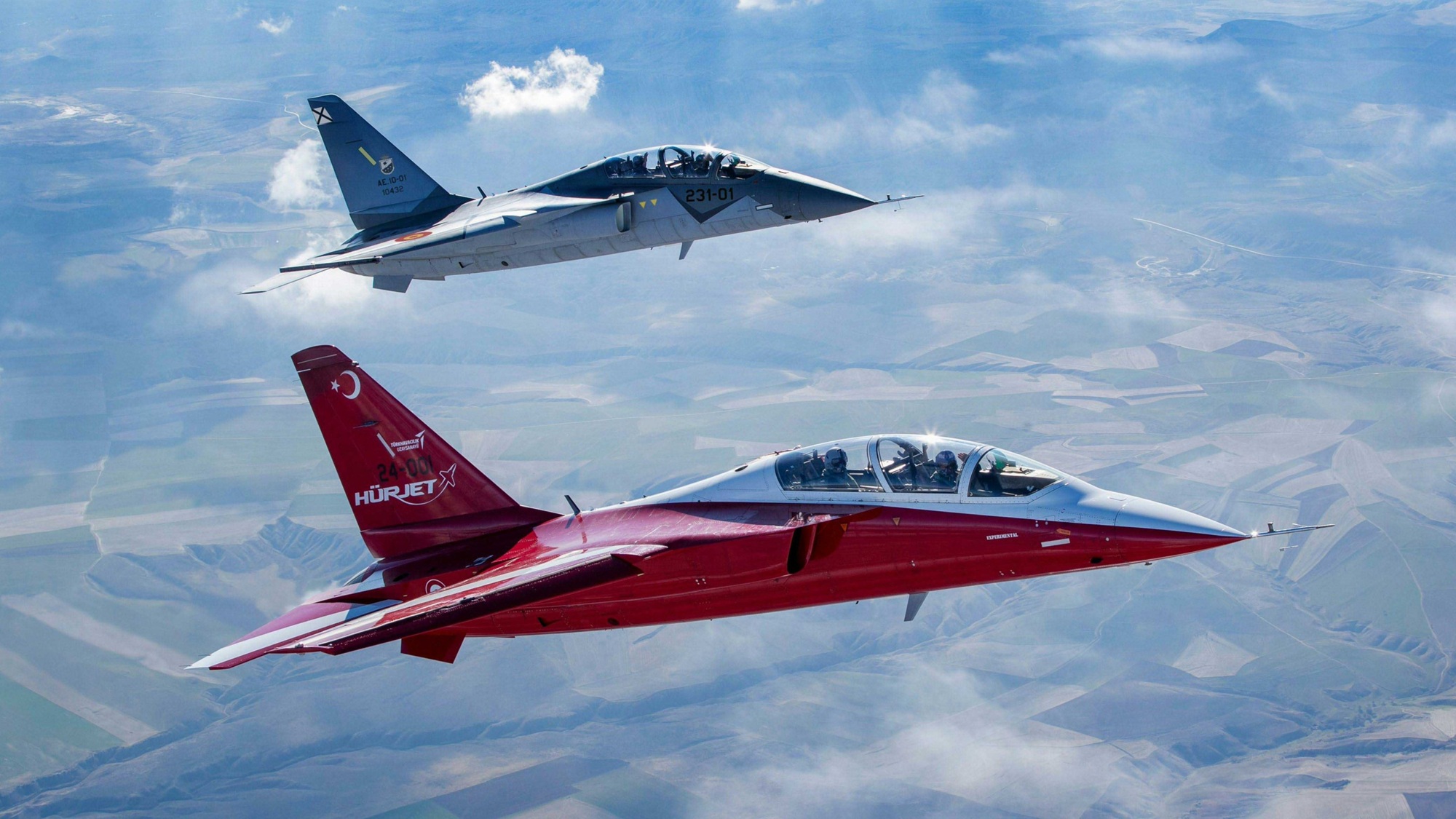
Spain signed a €2.4 billion contract to acquire Turkish Aerospace Industries’ Hürjets, with Airbus leading the work on the new Integrated Training System.
The Spanish government has signed the contract for acquiring Türkiye’s Hürjet advanced jet trainer, made by the Turkish Aerospace Industries (TAI), for the Ejército del Aire y del Espacio (Spanish Air and Space Force – SASF). The contract was signed on Dec. 28, making Spain the first export customer of the new trainer.
Two days later, on Dec. 30, Airbus Defence and Space announced that it has been contracted by the Spanish Ministry of Defense to lead the development and implementation of the new combat Integrated Training System (ITS-C). Airbus previously signed a cooperation agreement with TAI to divide the workshare for the Spanish procurement of the trainer.
Reports from Anadolu Ajansi and AviationWeek have mentioned the Dec. 28 contract is valued at €2.4 billion ($2.8 billion). Airbus did not disclose a value in the Dec. 30 press release, although this might be still referring to the Dec. 28 contract.
Airbus represents the group of Spanish aerospace companies participating in the project that involves acquiring 30 Hürjet jet trainers from TAI and adapting them with Spanish systems before the delivery to the SASF through 2028 and 2029. Although the Spanish government approved in September the acquisition of up to 45 aircraft, only 30 airframes have been mentioned in the contract.
As 30 airframes was the number which was mentioned also in the previous agreement, we can’t exclude the possibility the missing 15 aircraft will be part of an option that Spain can decide to confirm later.
The @DefensaGob has selected Airbus Defence and Space to lead the development and implementation of the @EjercitoAire’s new combat Integrated Training System (ITS-C).
The contract, led jointly by Airbus, as national coordinator for Spain, and @TUSAS_EN as the manufacturer of the… pic.twitter.com/tBjJXUiHm3
— Airbus Defence (@AirbusDefence) December 30, 2025
Spanish contract
Türkiye’s Defence Industry President Haluk Görgün was among the first to comment on the contract. “This agreement is a high-value-added, multi-dimensional defense industry export package that includes the export of Hürjet, an integrated training architecture covering advanced combat pilot training, ground-based simulation and training systems, maintenance and sustainment infrastructure, and long-term operational support elements,” said Görgün.
Highlighting its role as the “national coordinator” for Spain, Airbus said the contract’s primary objective is the “replacement of the current F-5 aircraft fleet and the coverage of the entire advanced training process for Spanish combat pilots.”
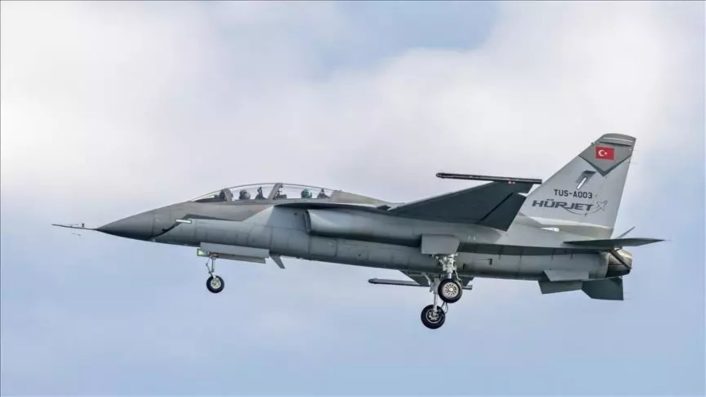
This includes the acquisition of 30 Hürjet jet trainers from Turkish Aerospace, the “conversion of the fleet with Spanish content according to the customer’s requirements, the creation of an Aircraft Conversion Centre in Spain, the refurbishment of the Training Centre at the Fighter and Attack School at Talavera la Real Air Base, Extremadura, and the provision of an integrated set of operation and maintenance services at this base.”
Airbus explained the program includes two phases, which would be executed simultaneously. The first phase involves the delivery of 30 Hürjets “in their initial configuration,” which will be certified in Spain and delivered to the SASF between 2028 and 2029.
In the next phase, the 30 aircraft would undergo “conversion” with “national content” and would be delivered in batches to the SASF from the second half of 2031 through 2035. The conversion of the first two aircraft will be carried out at the Airbus facilities in Getafe, while the other 28 aircraft will be converted at the new Conversion Centre to be established in Spain.
Strategic agreements for the export of HÜRJET to Spain have been signed with Airbus. ✈️
This development regarding the export of our HÜRJET Jet Trainer aims to strengthen Türkiye’s position in the European aviation market through its advanced technological competence. pic.twitter.com/C28UH8Kfhn
— Turkish Aerospace (@TUSAS_EN) July 24, 2025
Head of Air Power at Airbus Jean-Brice Dumont said in the press release: “This ambitious programme seeks to create a state-of-the-art combat training system in Spain that addresses the immediate needs of the Air and Space Force. It will also boost national industry participation, return on investment and capability development, ensuring Spanish sovereignty throughout the entire process.”
Spanish Defense Minister Margarita Robles had previously emphasized in the country’s Parliament on the economic, industrial and life-cycle benefits of having the aircraft converted in Spain in an assembly line with Spanish aerospace technology.
Spanish systems
The Airbus press release mentioned some of the Spanish systems and technologies that would go into the Hürjets, produced by several small and medium-sized aerospace companies. These include mission and training systems, remote interface units, audio management systems, avionics computers, mission recording or armament simulators.
Furthermore, the creation of a new Ground Based Training System (GBTS) by Airbus, together with other Spanish companies, is planned for 2028 at Talavera la Real Air Base. This center will feature different levels of simulation, including two mission simulators, virtual reality simulators, computer-based training and multi-purpose rooms, among other systems.
This new integral combat training system also includes a services package to ensure the highest availability of the new fleet, as well as the correct operation of the Training Centre and the ground instruction.
🔵🇹🇷 HÜRJET heading to 🇪🇸Spain
🔸Up to 45 HÜRJET aircraft will be delivered to Spain. 🔸The aircraft will be produced at TUSAŞ facilities, and the customization process to meet the needs of the Spanish Air Force will be carried out at Airbus Defence and Space facilities. pic.twitter.com/m13uEKjBXt
— Defence Turk English (@Defence_Turk_EN) September 24, 2025
Spanish and Turkish negotiation for Hürjet
Things began moving after Spain assessed the Hürjet prototype between July and August 2024 at Torrejon Air Base, near Madrid. A December 2024 Memorandum of Understanding (MoU) between Türkiye’s Presidency of Defense Industries (SSB) and the Spanish Ministry of Defense then followed, formally selecting the Hürjet as the future trainer.
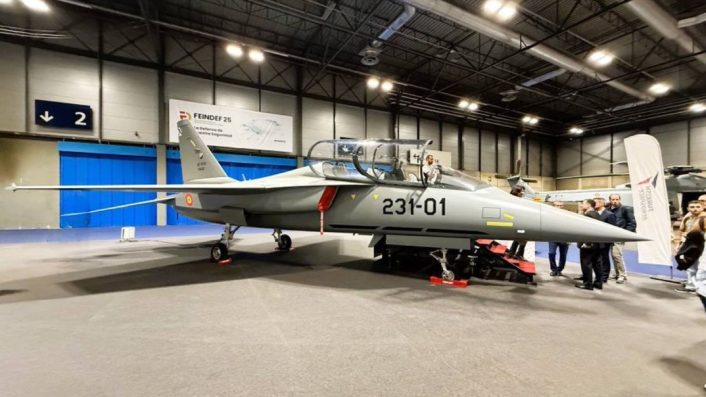
Then, in May 2025, TAI revealed the full-sized model of the Hürjet with SASF markings for display at the Feindef 2025 exhibition in Spain. A July 30, 2025, agreement between TAI and Airbus Defence and Space at the IDEF (International Defense Industry Fair) 2025, outlined that 30 jets would be acquired for the Spanish Air and Space Force (SASF), with deliveries expected to begin in 2028.
The agreement clarified the roles of Airbus and TAI in the program. Airbus represented the group of Spanish companies participating in the project, and this agreement enabled Turkish and Spanish engineers to determine the subsystems that would go into the aircraft, while also assessing how each would impact the cost and delivery timelines. As it now turns out, those discussions have concluded.
🇹🇷🇪🇸 | El avión de entrenamiento a reacción HÜRJET, de producción nacional turca, fue seleccionado por la Fuerza Aérea y Espacial Española para la compra de 30 unidades. El proyecto asciende a 2.600 millones de euros y las entregas comenzarán en 2028.pic.twitter.com/aiKgooQh4h
— AlertaNewsPlus (@AlertaNewsPlus) December 29, 2025
A major concern was that a production line in Spain was not considered feasible for the small number of airframes Madrid plans to buy, which then reflected in the Spanish government’s Sep. 24, 2025 approval for 45 Hürjets. Spanish and Turkish industries would cooperate to develop the broader Integrated Training System-Combat (ITS-C) centered around the Hürjet for Spanish use.
The SASF’s Hürjets would be assigned to the Ala 23 (23rd Wing) at Talavera La Real Air Base, which currently operates the 19 F-5Ms still in service. The F-5Ms are used to train pilots as part of the Fighter and Attack Phase to fly the Eurofighter Typhoons and F-18 (Spain doesn’t use the F/A-18 Designation for its Hornets).
#Spain #Signs #Contract #Hürjets

Leave a Reply